Alex Potanin
Senior Visiting Fellow; Associate Professor, ANU
Research Interests
Alex's research area is programming languages and software verification. His contributions to type systems around ownership, immutability, and capabilities redefined the security guarantees that modern software engineering can provide. He is currently working on some ideas for the modern module systems designs based on capabilities, combinations of abstract and algebraic effects, including for the world of fully verified and secure software targeting embedded and quantum computing systems.
Contact Details
| Email: | alex.potanin@anu.edu.au |
|---|---|
| Web: | https:/ |
| GitHub: | potanin |
More contact information is available at the Contact page.
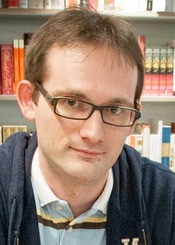
My research area is programming languages and software verification. I work on the mathematical principles that define the behaviour of the essential tools that software engineers use to craft all the fantastic technology surrounding us today. My contributions to type systems around ownership, immutability, and capabilities redefined the security guarantees that modern software engineering can provide.
Impact: My work over the first decade of my career involved the concepts of ownership and immutability, and how to provide usable language support for both with the help of type parameters. My approach has now been widely adopted by the Rust programming language as “lifetime parameters”. In the second decade, I worked on the design and production of a usable and secure programming language called Wyvern that utilises object capabilities and effects. A popular configuration language called CUE is used widely within Alibaba’s cloud and service configuration. CUE based its module system design on the Wyvern modules.
Alex completed his PhD in 2006 on Generic Ownership - showing how type polymorphism can be used to provide ownership type support in any language, such as the modern-day Rust Programming Language that popularised this approach. Alex went on to show deep connections between ownership and immutability with the help of the Royal Society of New Zealand Marsden Funding in 2008 - 2011 with a book chapter on Immutability outlining all the core outcomes of this novel approach.
After a full-year sabbatical at what was then the Institute for Software Research at Carnegie Mellon University, working with Professor Jonathan Aldrich, I have created a novel general-purpose Wyvern Programming Language designed from the ground up with security and usability as its primary goals. Many students and publications came out of that project over the following decade, including novel ideas for type-specific languages and decidable typing for type members - some of which are reflected in the modern generation of the industrial Scala Programming Language.
I am currently working on some ideas for the modern module systems designs based on capabilities, combinations of abstract and algebraic effects, and other programming language design ideas, including for the world of fully verified and secure software targeting embedded and quantum computing systems.
Projects
Pancake, Fiducia, Microkit
Collaborations
• Professor Jonathan Aldrich, CMU, USA (Wyvern, capabilities, type members) • Professor Ina Schaefer, KIT, Germany (correct-by-construction, information flow) • Assistant Professor Liyi Li, Iowa State University, USA (quantum program verification, symbolic execution) • Professor Atsushi Igarashi, Kyoto University, Japan (ownership verification) • Professor Ilya Sergey, NUS, Singapore (Rust, deductive synthesis)
Career Summary
2022 – Present Associate Professor, Australian National University 2023 – Present Adjunct Professor, S3D, Carnegie Mellon University, USA 2025 – Present Senior Visiting Fellow, School of Computer Science and Engineering, UNSW Sydney 2025 Research Consultant, Usability Dynamics Inc, NC, USA 2025 Research Consultant, Skykraft, Canberra, Australia 2023 – 2025 Associate Director, HDR, School of Computing, ANU 2022 – 2025 Adjunct Professor, ECS, VUW, NZ 2022 Deputy Head of School, Victoria University of Wellington 2021 – 2022 Associate Dean (Students), Victoria University of Wellington 2018 – 2022 Associate Professor, Victoria University of Wellington 2019/20 (sabbatical) Associate Professor, Kyoto University, Japan 2010 – 2017 Senior Lecturer, Victoria University of Wellington 2013 (sabbatical) Research Scholar, Carnegie Mellon University 2006 – 2009 Lecturer, Victoria University of Wellington 2005 – 2006 Software Engineer, Innaworks Limited 2004 Visiting Researcher, Purdue University 2001 – 2003 Software Engineer, Catalyst Systems Limited (part-time)
Qualifications
BSc(Hons), PhD, Victoria University of Wellington, New Zealand MIEAust
Affiliations
Australian National University
Patents
https://patents.google.com/patent/EP2122464A4
Grants
2026 - 2027 To be announced soon (shared with Dr Ben Swift) $500,000 (in-kind) 2025 - 2026 Skykraft Industry Research Grant (multiple rounds) $30,000 2024 DVCRI University Strategic Fund towards Centre of Excellence on Trustworthy Systems $36,000 2022 ANU Startup Package Funding $500,000 2021 - 2023 SHEADI Faculty Strategic Initiative PhD Scholarship $100,000 2020 - 2021 Robonomics Network Research Grant $72,000 2019 Kyoto University Visiting Professor Scholarship $20,000 2017 - 2018 Oracle Corporation Research Grant $70,000 2013 Carnegie Mellon University Visiting Researcher Funding (DARPA Lablet) $25,000 2012 Mozilla Foundation Research Grant $15,000 2009 - 2011 Royal Society of NZ Marsden Fast Start Grant $300,000 2009 RSNZ ISAT Grant $5,420 2007 - 2016 VUW University Research Fund (multiple rounds) $47,000
High-Level Advisory Roles
Member at Large and Treasurer, ACM SIGPLAN Executive Committee, 2025–2027 Senior Member of the ACM Member of Engineers Australia Permanent Elected Member of IFIP 2.4 Working Group on Software Implementation Technology
Steering Committees
Chair, SPLASH Steering Committee, 2024–2026 SPLASH/OOPSLA Steering Committee Member from 2020 (Chair from 2024) SAPLING Steering Committee Member from 2019 PC Chair, APLAS 2025 General Chair, APLAS 2018, Wellington, NZ Program Co-Chair, APSEC 2016 (with Gail Murphy) PC Co-Chair, CATS 2010 and 2011 (with Taso Viglas) General Co-Chair, ACSW 2009, Wellington, NZ
Program Committees and Editorial Boards
PLDI 2025, FSE-IVR 2025, OOPSLA (2021 ERC, 2020, 2019, 2014, 2011 ERC), ECOOP (2023, 2022, 2019, 2016), ESOP 2021, APLAS (2021, 2016), GPCE (2020, 2019), PLDI 2015 (ERC), HotSoS 2019, PLDI SRC 2019, FTfJP 2016, NOOL 2016, IWACO (2024, 2021, 2011, 2007), FormaliSE (2023, 2022), Programming (2023, 2022), Onward! Papers 2023, FOOL 2014, ACSC (2010–2017).
Recognition and Awards
• 2026 – ESOP/ETAPS 2026 Distinguished Paper Award • 2024 – ECOOP 2024 Distinguished Artifact Award • 2022 – FORTE 2022 Best Paper Award • 2017 – ECOOP 2017 Distinguished Artifact Award • 2014 – ECOOP 2014 Distinguished Paper Award • 2007 – ESEC/FSE ACM SIGSOFT Distinguished Paper Award • 2005 – 2nd Prize and Judges Prize at ICFP Programming Contest 2005 and 2003 • 2004 – Claude McCarthy Fellowship; 2003 – J. L. Stewart Scholarship • 2003 – 2nd Place, ACM International Research Competition (via OOPSLA 2002 SRC)